


 App Store
  Google Play
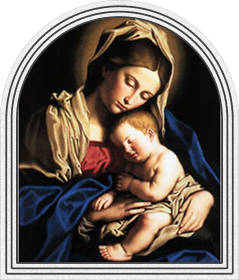
The Prayer Life of the Blessed Virgin Mary: A Model of Contemplative Faith

Introduction
The Virgin Mary provides us with an example of deep contemplative prayer and meditation within Scripture. Very little of what the Scriptures record about Mary’s prayer life reveal her daily practices, but they provide glimpses into her heart to discover a woman with a strong interior prayer life who “treasured all these things and pondered them in her heart” (Luke 2:19, NIV).
Mary’s Pondering Heart: The Foundation of Christian Contemplation
Twice in the Gospel of Luke, we read that Mary “pondered” or “treasured” things in her heart (Luke 2:19, 2:51). The Greek word used here—symballousa—conveys a bringing together, or a comparing, a deep meditation upon the mysteries of God. Mary “pondered” events in prayer and submitted these things to the Holy Spirit to guide her in understanding their meaning.
This wasn’t casual thinking—it was the kind of contemplative prayer that the Desert Fathers and Christian mystics would later recognize as lectio divina in lived form.
Mary did not merely experience events; she held them in her heart, prayed about them, and allowed the Holy Spirit to teach her their meaning. The practice of pondering, the process of holding the Word of God and His works in sustained prayerful attention, comprises the core of Christian contemplative life.
“Be still, and know that I am God” (Psalm 46:10, NIV) takes on profound meaning in Mary’s life. She embodied this stillness, this receptive waiting upon the Lord.
The Annunciation: A Prayer of Complete Surrender
Mary’s response to the angel Gabriel illustrates the depth of her prayer life:
I am the Lord's servant. May your word to me be fulfilled.
Luke 1:38, NIV
This expresses not only total surrender but active obedience.
Mary’s immediate question—”How will this be, since I am a virgin?” (Luke 1:34, NIV)—indicates she engaged in genuine dialogue with God. She sought understanding while remaining open to divine mystery. This is the essence of mystical prayer: honest questioning combined with absolute trust.
The psalmist wrote,
Trust in the LORD with all your heart and lean not on your own understanding.
Proverbs 3:5, NIV
Mary fully illustrated this; although she did not fully understand, she completely trusted.
The Magnificat: Prayer as Prophetic Praise
When Mary went to visit Elizabeth, her prayer overflowed into what is known as The Magnificat (Luke 1:46-55). This was not a prepared speech, but an eruption of a heart saturated in Scripture and prayer. Mary’s prayer echoes Hannah’s prayer and contains quotations from many of the Psalms and prophetic writings.
My soul glorifies the Lord and my spirit rejoices in God my Savior.
Luke 1:46-47, NIV
This illustrates that Mary formed her identity around God’s glory, not her own. She was so deeply immersed in prayer that praise poured out spontaneously. If we would like to live as Mary lived, we must be so transformed by prayer that it becomes part of our identity. As Paul wrote,
“Pray continually” (1 Thessalonians 5:17, NIV)—Mary lived this reality.
Silent Meditation in Crisis
As we study the ministry of Jesus, we can see that many times we find Mary in moments of quiet presence, and it is in that silence where we can see the great depth of her meditation and contemplation. At the wedding of Cana (John 2:1-11), when there was a need for wine, Mary noticed the need and took it to Jesus with simple faith: “They have no more wine.” Mary showed her contemplative wisdom to the servants by telling them:
Do whatever he tells you.
John 2:5, NIV
This is what contemplative prayer produces: a clear view of what is needed in a situation, simple intercession on behalf of others, and the ability to help others to be obedient. Through contemplative prayer, Mary had learned how to wait for the perfect time and methods of the Lord .
Standing at the Cross: Prayer in Suffering
Mary’s presence at the Crucifixion (John 19:25-27) is the ultimate way to show a true form of contemplative prayer—a type of prayer that is expressed through silent suffering and union with God’s will. At the foot of the Cross, Mary did not argue, nor did she leave or make a discussion of why her son was dying. She simply stood.
Though he slay me, yet will I hope in him.
Job 13:15, NIV
This was Mary’s total trust that God would prevail even when her understanding of His plan was dark. Down through the ages, Christian mystics have recognized the same experience of pure faith persevering despite the hiddenness of God, and this is what is often called the “dark night of the soul.”
Mary’s meditation on the words of the angel and Simeon’s prophecy that “a sword will pierce your own soul too” (Luke 2:35, NIV), with the mysterious acts of her Son prepared her to stand in prayer when all the visible appearances seemed to contradict God’s promises.
In the Upper Room: Persistent Prayer
After the Resurrection and Ascension, we find Mary in the Upper Room with the disciples, “all joined together constantly in prayer” (Acts 1:14, NIV). Even after all the events she had witnessed, Mary’s example shows that contemplative prayer never ends at a certain point in time. By being overshadowed by the Holy Spirit (Luke 1:35), Mary did not stop seeking God’s presence and continued to do so with the community of believers. The contemplative life is a continuous process of seeking:
This shows us that contemplative prayer isn’t about achieving a spiritual summit and then ceasing to climb. Mary continued to seek God’s presence with the community of believers. The contemplative life is one of continual seeking:
You will seek me and find me when you seek me with all your heart.
Jeremiah 29:13, NIV
Lessons from Mary’s Prayer Life
1. Prayer as Listening: Mary’s life demonstrates the principle that God invites us to pray to Him. Before she could respond with a “yes,” she first listened to the voice of God inviting her .
2. Meditation on Scripture: Her Magnificat reveals that she had hidden God’s Word in her heart (Psalm 119:11). Contemplative prayer requires that we fill our minds with Scripture so the Holy Spirit can bring it to remembrance .
3. Prayer in All Circumstances: Mary prayed during all the situations of her life—it is in this sense that Mary is an example of praying “in every situation” as Paul wrote (Philippians 4:6, NIV) .
4. The Prayer of Presence: For Mary, it was often more powerful to be with another person and to wait upon the Lord in silence than to explain all that was happening .
5. Surrender and Trust: The fiat of Mary was “let it be”—her important act of surrendering herself to the will of God. This same act was demonstrated by Jesus in the Garden of Gethsemane:
Not my will, but yours be done.
Luke 22:42, NIV
Conclusion
Mary’s prayer life is an invitation for us to enter into the tradition of Christian devotion through contemplative prayer—not as a way to escape reality, but as the way to engage fully in the reality of God that is breaking into our world. Mary’s pondering heart, her surrender to God’s Word, her prophetic praises, her silent sufferings, and her constant seeking highlight the same invitation Jesus gave:
Come to me, all you who are weary and burdened, and I will give you rest.
Matthew 11:28, NIV
In a chaotic, noisy world filled with distractions, Mary calls us back to a stillness, a meditative heart, a kept heart—the practice of treasuring God’s works in our hearts. Mary shows us that contemplation is not limited to monks in monasteries; every believer who earnestly seeks to follow her example is entitled to the contemplative life: “May your word to me be fulfilled” (Luke 1:38, NIV).
As the psalmist wrote,
As the deer pants for streams of water, so my soul pants for you, my God.
Psalm 42:1, NIV
Mary’s life of prayer demonstrates this holy thirst, and in doing so, she becomes a model for all who would seek God with their whole heart.
Our Editorial Standards:
All our content on Christian meditation traditions, prayers, and spiritual practices is reviewed by Dr. Megan Remington, PhD, ensuring theological soundness and spiritual depth.
We draw from centuries of Christian contemplative tradition, citing respected theological sources, biblical references, and established spiritual practices.
Our team understands that spiritual struggles are deeply personal. We approach topics of anxiety, strength, healing, and peace with compassion and biblical wisdom.
We continuously review and update our spiritual resources to ensure they remain relevant and aligned with orthodox Christian teaching.
Each article clearly identifies our writers and reviewers, along with the theological sources and biblical foundations used.
 To guarantee that all of our information is accurate, we ensure that all our sources are reputable. That means every source is authenticated and verified to be backed only by medical science.