

 App Store
  Google Play
History of Meditation in Catholicism
Catholic Teachings & Historical Practices of Meditation


Meditation Traditions In Catholicism
The tradition of meditation carries a strong theme within the Catholic faith. Catechism 2705 states this:
Meditation is, above all, a quest. The mind seeks to understand the why and how of the Christian life in order to adhere and respond to what the Lord is asking.
The quest of meditation offers an opportunity to explore the Word of God and connect with Jesus Christ and the divine in a supernatural way.
Catholic and Monastic Church Fathers Who Influenced Meditation
God’s Word is rich with proof of His lovingkindness and care for His children. Sleep and rest are critical for healthy functioning, but they can be elusive in times of trial or when you’re feeling anxious. Meditate on these verses and pray through the promises God shares with us.
Desert Fathers and Mothers
Many denominations that practice the Christian tradition of meditation claim the works and teachings of the Desert Fathers and Mothers from the 3rd century. This was a group of spiritual pioneers who sought solitude in the remote wilderness of Egypt for the sake of spiritual growth.
They founded a monastic community, and one of their core teachings was contemplative prayer and meditation. The collection of their works, Apophthegmata Patrum, is now available in print under the title Sayings of the Desert Fathers, which can be purchased or found online in its entirety.
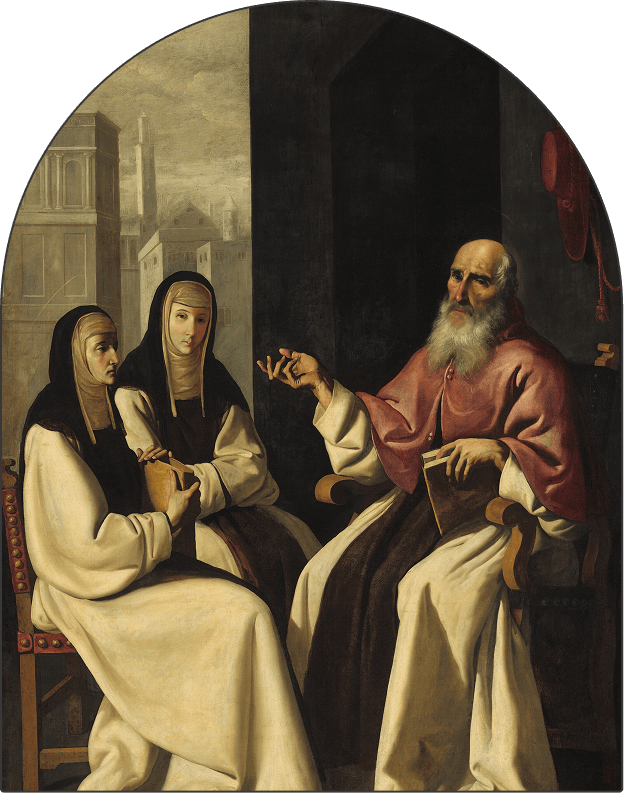
The section, The Twelve Anchorites, outlines the practices of 12 desert fathers for how they live in solitude and what spiritual disciplines they follow, which include prayer, meditation, how to fight temptation, and how to constantly keep God at the forefront of thought.[1] One account details how he creates a wall in his mind, between himself and the outside world, to keep hope in God and ignore distractions. Another maintains a pilgrim’s mindset that today is the first and only day he has to serve God and must not be attached to other things or ideas.
The fourth Anchorite practices imaginative prayer, picturing himself with Jesus to imitate life at that time. The seventh constantly repeats “faith, hope, and charity” to himself, over and over, without interruption. Anchorite number nine recounts how he contemplates angelic worship with such intensity that he is not drawn by early things.
Through imaginative prayer, constant inner watchfulness, and radical self-examination, these, and many other examples from Sayings of the Desert Fathers, offer practical insight into the Catholic tradition of Christian contemplation and other forms of meditation
St. Augustine
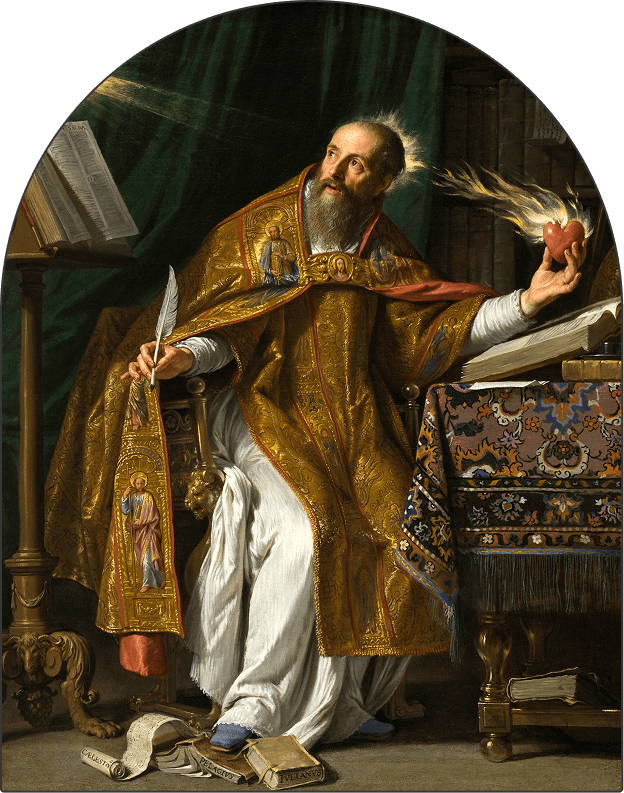
St. Augustine is an iconic figure in the history of the Catholic church. He died in the 5th century, but not before developing what is now known as Augustinian Meditation. This method of meditation involves scripture recitation, where you insert yourself into the passage by name.[2]
For example, if Jesus is speaking to the rich young ruler, you would instead insert your own name when reciting the passage. This is viewed as a silent mental prayer and a space to personally join Christ, both as a corporate group or as an individual.
St. John of The Cross
St. John is the author of The Ascent of Mount Carmel. This work marks a transition in meditative practices from the practical, step-by-step process to a more ethereal, spiritual, and supernatural experience.
St. John explains in The Ascent of Mount Carmel that total detachment is required for this experience so that the soul is free of earthly desires and possessions. Denying these more base senses clears space for one to be infused with grace. To experience a transformation “in God” and become one with Him.
In chapter 14 of his work (which some attest was influenced by the letters of contemporary St. Teresa of Avila), St. John describes three indicators that one is being called from practical or discursive meditation into a more supernatural experience:[3]
- They are dissatisfied with the old method
- They long to experience the presence of God
- They struggle to engage with the old method
Be Infused With Grace Through Deep, Spiritual Meditation
Start your meditation journey today - download the app.
 Download on the App Store
 Get it on Google Play
Catholic Catechism & Practice
Within the official catechism of the Catholic Church, several mentions of meditation and Christian prayer are further evidence that this spiritual practice has a place in modern faith:
Catechism 2706:
To meditate on what we read helps us to make it our own by confronting it with ourselves…we discover in meditation the movements that stir the heart, and we are able to discern them. It is a question of acting truthfully in order to come into the light…
Catechism 2707:
There are as many and varied methods of meditation as there are spiritual masters. Christians owe it to themselves to develop the desire to meditate regularly…But a method is only a guide; the important thing is to advance, with the Holy Spirit, along the one way of prayer: Christ Jesus.
Catechism 2708:
Meditation engages thought, imagination, emotion, and desire. This mobilization of faculties is necessary in order to deepen our convictions of faith, prompt the conversion of our heart, and strengthen our will to follow Christ. Christian prayer tries above all to meditate on the mysteries of Christ, as in lectio divina or the rosary. This form of prayerful reflection is of great value, but Christian prayer should go further: to the knowledge of the love of the Lord Jesus, to union with him.
Lectio Divina
Lectio Divina (or divine reading) is one of the most common and popular forms of meditation and contemplative prayer. The Benedictine practice began in the medieval era and is believed to have been founded by St. Benedict of Nursia. When practicing Lectio Divina, one prays slowly and intentionally over Scripture or by praying the Rosary to develop a closer bond with God through His Word.
Ignatian Meditation
St Ignatius of Loyola is the father of Ignatian meditation, the spiritual exercise of insight meditation.[5] This form of meditation focuses on a Bible passage and imagines yourself as an active participant in the conversation or events in the texts to gain insights into the truths found therein.
The Cloud of Unknowing
The Cloud of Unknowing is a 14th-century spiritual guide that teaches the practice of contemplative prayer for the purpose of exploring the fathomless mysteries of God and spirituality. Though the author is anonymous, their work has inspired the Centering Prayer and other forms of Christian meditation.
It is explained that only loving presence or contemplation allows us to transcendently know God on a deeper level, as it states:
That by virtue of this work a sinner truly turned and called to contemplation cometh sooner to perfection than by any other work; and by it soonest may get of God forgiveness of sins. [6]
Though translated into old-school Middle English, instructions in the Cloud of Unknowing reveal specific methods for practicing Christian meditation and this form of prayer: [7]
Here, the instruction is to focus on a one-syllable word and repeat it over and over. This will clear the mind of all thought and release one’s intellect from interfering with greater spiritual possibilities: [8]
So take a little word of just one syllable to help focus your attention. The shorter the word, the better, because it is more like this particular activity of the Holy Spirit. Choose a word like “God” or “love” or any word of one syllable that appeals to you and impress it indelibly on your heart so that it is always there, whatever happens….Use this little word and pray not in many words but in a little word of one syllable… With this word, you will suppress all thoughts.
In the following section, the work details what the first session of transcendental meditation will feel like, “darkness” and “a cloud of unknowing” that is not fully seeing or feeling God, but empowers a pure, wordless desire for him, keeping your heart set on the divine: [9]
For at the first time when thou dost it, thou findest but a darkness; and as it were a cloud of unknowing, thou knowest not what, saving that thou feelest in thy will a naked intent unto God. This darkness and this cloud is, howsoever thou dost, betwixt thee and thy God, and letteth thee that thou mayest neither see Him clearly by light of understanding in thy reason, nor feel Him in sweetness of love in thine affection.
This medieval text goes on to discuss the state of consciousness required to “feel Him” through the “spark of the soul,” which circumvents the intellect:[10]
Further, there is to be no wilful choosing of method: no fussy activity of the surface-intelligence. The mystic who seeks the divine Cloud of Unknowing is to be surrendered to the direction of his deeper mind, his transcendental consciousness: that “spark of the soul” which is in touch with eternal realities.
Our Editorial Standards:
All our content on Christian meditation traditions, prayers, and spiritual practices is reviewed by Dr. Megan Remington, PhD, ensuring theological soundness and spiritual depth.
We draw from centuries of Christian contemplative tradition, citing respected theological sources, biblical references, and established spiritual practices.
Our team understands that spiritual struggles are deeply personal. We approach topics of anxiety, strength, healing, and peace with compassion and biblical wisdom.
We continuously review and update our spiritual resources to ensure they remain relevant and aligned with orthodox Christian teaching.
Each article clearly identifies our writers and reviewers, along with the theological sources and biblical foundations used.
 To guarantee that all of our information is accurate, we ensure that all our sources are reputable. That means every source is authenticated and verified to be backed only by medical science.
Join The Saints That Have Gone Before In Meditation | Get The Christian Meditation App Today
Be infused with grace to experience a transformation in God and become one with the divine. Begin your meditation journey today.
FAQ’s About Christian Meditation
Is meditation safe for Christians?
Absolutely! There is much confusion and suspicion surrounding meditation for Christians, and it is often miscategorized as a pagan or new-age practice. However, through much Biblical study and research into ancient Christian traditions, it is apparent that meditation, contemplative prayer, and mindfulness are all accepted practices that align with Scripture and enhance the believer’s life.
What are your academic qualifications?
Absolutely! There is much confusion and suspicion surrounding meditation for Christians, and it is often miscategorized as a pagan or new-age practice. However, through much Biblical study and research into ancient Christian traditions, it is apparent that meditation, contemplative prayer, and mindfulness are all accepted practices that align with Scripture and enhance the believer’s life.
Is the Christian Meditation App appropriate for beginners?
Absolutely! There is much confusion and suspicion surrounding meditation for Christians, and it is often miscategorized as a pagan or new-age practice. However, through much Biblical study and research into ancient Christian traditions, it is apparent that meditation, contemplative prayer, and mindfulness are all accepted practices that align with Scripture and enhance the believer’s life.
What is the first session like?
Absolutely! There is much confusion and suspicion surrounding meditation for Christians, and it is often miscategorized as a pagan or new-age practice. However, through much Biblical study and research into ancient Christian traditions, it is apparent that meditation, contemplative prayer, and mindfulness are all accepted practices that align with Scripture and enhance the believer’s life.
Sources

All Catechism references were cited from: Catholic Cross Reference. https://www.catholiccrossreference.online/catechism/
- The anonymous sayings of the desert fathers. Internet Archive. (n.d.). https://ia800408.us.archive.org/25/items/TheAnonymousSayingsOfTheDWortleyJohn5090/The%20Anonymous%20Sayings%20of%20the%20D%20-%20Wortley,%20John_5090.pdf
- Meditation and reflection. Catholic Identity. (n.d.-a). https://catholicidentity.bne.catholic.edu.au/scripture/SitePages/Meditation-and-reflection.aspx?csf=1&e=aGrw1c
- Ascent of mount carmel. christian classics ethereal library. (n.d.). https://www.ccel.org/ccel/j/john_cross/ascent/cache/ascent.pdf
- Accepting the embrace of god: The ancient art of lectio divina. Saint Andrew’s Abbey. (2021a, November 10). https://saintandrewsabbey.com/our-daily-life/accepting-the-embrace-of-god-the-ancient-art-of-lectio-divina/?gad_source=1&gclid=EAIaIQobChMIvsWpl7jQiwMVSgCtBh20QQ3TEAAYASAAEgK0Z_D_BwE
- Meditation and reflection. Catholic Identity. (n.d.-a). https://catholicidentity.bne.catholic.edu.au/scripture/SitePages/Meditation-and-reflection.aspx?csf=1&e=aGrw1c
- The Cloud of Unknowing. catholic spiritual direction. (n.d.). https://www.catholicspiritualdirection .org/cloudunknowing.pdf